Bags & Pouches · Bench lead · 18 Bench hours · 3 min read
A 360 mm Messenger Bag: The Gusset Is the Whole Job
Everyone plans the flap and then improvises the gusset. The gusset is where the bag either holds its shape or collapses into a sack: a single 700 × 90 mm strip that runs from one end of the opening, down one side, across the bottom, up the other side and back to the other end of the opening. Eighteen hours, five main pieces, and the longest seam on this bench.
Materials
- Veg-tan cowhide5/6 oz, 0.32 m²
- Heavy flap hide8/9 oz, 0.13 m²
- Tuck locks25 mm brass, 2 sets
- Waxed thread0.6 mm black, about 40 m
Tools
- Pricking irons3.38 mm, 2 + 8 + 10 tooth
- Stitching ponythree days of it
- Pricking awlfor the gusset stack
- Round punch5 mm for the strap holes
- Edge creaserfor the flap perimeter
Bench hours
- 18 hBench lead
- 3.38 mmStitch pitch
- 0.6 mm waxed polyester, blackThread
- Vegetable-tanned cowhide, 5/6 oz body, 8/9 oz flapHide
- 5/6 oz body (2.0–2.4 mm), 8/9 oz flap (3.2–3.6 mm)Thickness
- Hardware
- 4 parts
- Cut list
- 5 pieces
- Published
- 2026-11-01
- Stitch pitch
- 3.38 mm
Cut list Hole array drawn from the spacing in the spec table; dimensions in millimetres.
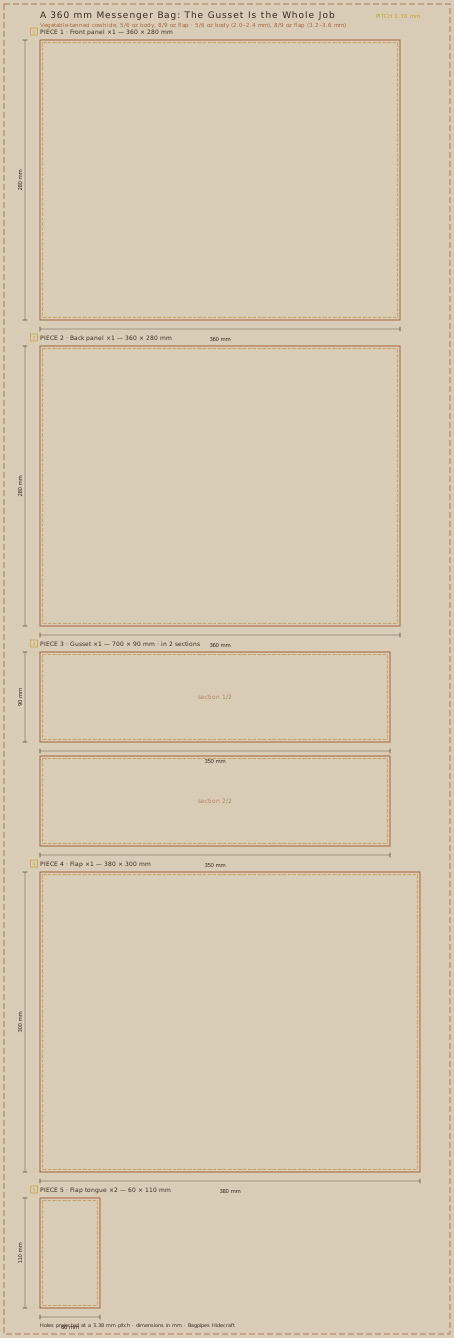
| Piece | Size (mm) | Qty |
|---|---|---|
| Front panel | 360 × 280 mm | ×1 |
| Back panel | 360 × 280 mm | ×1 |
| Gusset | 700 × 90 mm | ×1 |
| Flap | 380 × 300 mm | ×1 |
| Flap tongue | 60 × 110 mm | ×2 |
Bench sequence 3.38 mm · 0.6 mm waxed polyester, black
Lay the gusset out as one length, not three pieces
The gusset is one 700 mm strip: 280 mm down each side and 140 mm across the bottom leaves no waste, and one continuous piece has two seams instead of six. Cut at 90 mm wide and skive both long edges to 1.2 mm over a 10 mm band, because every millimetre at the gusset edge is a millimetre of leather the irons have to pass through.
Skive the two ends of the gusset down to 0.8 mm where they meet the front and back panels. The bag's whole silhouette is decided by how cleanly those two joints sit, and the skive is what lets the corner go from 90 mm to 20 mm of leather in a single fold.
Flap first, because it is the easiest thing to spoil
The flap is 380 × 300 mm cut from 8/9 oz. Heavier leather makes a flap that stands out from the bag and sheds rain away from the opening, which is the entire reason this design has survived a century. Crease and skive the two flap tongues at 60 × 110 mm and stitch them at the flap's lower corners with a double row.
Set the two tuck locks on the tongues before the flap goes anywhere near the bag. Tuck locks have a 1.5 mm tolerance window: set them after the flap is attached and the flap will not hang straight, because you will be working on a curved object instead of a flat one.
Attach the gusset from the bottom up
Stitch the gusset to the back panel first, starting at the centre of the bottom and working outward in both directions. Starting at a corner and going around means any drift accumulates at the bottom centre, which is the one place on the bag that everyone sees.
Then the front panel, then the gusset ends to each other, then the flap across the back top edge. Twenty stitches per seam at 3.38 mm pitch is 260 stitches per long seam, and there are four of them. Do not stop in the middle of a seam for the day: pick up where you left off and the tension change will be visible as a slack band three stitches wide.
Strap, hardware and the load test
The strap is a 25 mm, 1400 mm length with a 25 mm D-ring at one end and a rectangular ring at the other, adjustable through a second rectangular ring. Rivet the D-ring end with two rivets: the strap is the one part of a messenger bag that fails first, and a single-rivet strap end pulls out under a running shoulder.
Load the finished bag with 6 kg — a laptop, a charger, a notebook and a full water bottle — and carry it for half an hour. Then check the four gusset joints and both strap ends. A messenger bag with a failed strap end cannot be repaired without unpicking the flap, so the half hour costs nothing and saves the whole order.
Also filed under Bags & Pouches
Bags & Pouches · 2026-10-14
A Boxed Dopp Kit: Five Panels, Four Corners, Two Hands
A dopp kit is the first order where you build a three-dimensional object rather than a folded one.
- Bench hours
- 14 h
- Level
- Bench lead
Kit profiles
Care & Feed
Care and Feed: Less Often Than You Think
More leather is ruined by over-oiling than by neglect.
- Rows filed
- 5
Hides
Vegetable-Tanned or Chrome-Tanned: The Choice That Fixes Everything Else
Almost every technique on this bench assumes vegetable-tanned leather.
- Rows filed
- 4
Adhesives
Adhesives: Contact Cement, Open Time and the Ventilation Rule
Contact cement is the strongest and the most misused adhesive on this bench.
- Rows filed
- 5