Cases & Covers · Bench lead · 12 Bench hours · 3 min read
A Wet-Moulded Half Case With a Tripod Boss
A half case has to do two things at once: hold the camera body tightly enough that it does not slide, and let the tripod socket through at exactly the right height. The only reliable way to get both is to mould the leather wet over the actual camera. Twelve hours, 0.13 m² of 2.4 mm veg-tan, and a lot of waiting.
Materials
- Veg-tan cowhide2.4 mm, 0.13 m²
- Waxed polyester thread0.6 mm black, about 11 m
- Casein or acrylic finish1 coat on the outside
Tools
- Plaster or MDF formshaped to the camera body
- Pricking irons3.85 mm, 2 + 8 tooth
- Strap cutterset to 24 mm
- Skiverfor the 1.0 mm wrap edges
Bench hours
- 12 hBench lead
- 3.85 mmStitch pitch
- 0.6 mm waxed polyester, blackThread
- Vegetable-tanned cowhide, 2.4 mm, wet-moulded over a plaster formHide
- 5/6 oz (2.0–2.4 mm)Thickness
- Hardware
- 3 parts
- Cut list
- 4 pieces
- Published
- 2026-10-21
- Stitch pitch
- 3.85 mm
Cut list Hole array drawn from the spacing in the spec table; dimensions in millimetres.
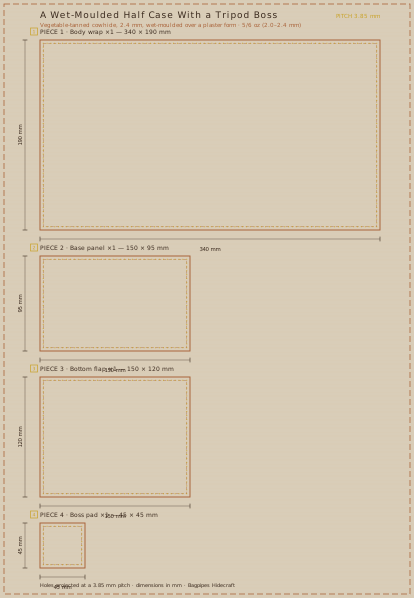
| Piece | Size (mm) | Qty |
|---|---|---|
| Body wrap | 340 × 190 mm | ×1 |
| Base panel | 150 × 95 mm | ×1 |
| Bottom flap | 150 × 120 mm | ×1 |
| Boss pad | 45 × 45 mm | ×1 |
Bench sequence 3.85 mm · 0.6 mm waxed polyester, black
Case the leather properly before it goes near the camera
Casing is not soaking. Submerge the 2.4 mm panel in room-temperature water for 45 seconds, wrap it in a towel, and leave it for two hours. It should feel cool and dry to the touch but take a thumbprint. Leather taken straight from the bath will stretch beyond recovery and dry hard as a board; leather cased properly moulds around edges and holds the shape.
Wrap the camera in a single layer of cling film first. The film is what stops the leather from taking a print of the dials and the grip texture — a half case that has the shutter release moulded into it looks like a mistake, not a feature.
Mould from the base up, in one direction
Sit the camera on the 150 × 95 mm base panel and press the cased wrap around the body with a bone folder, working from the base upward in one continuous sweep. Do not go back and forth: each reversal pushes the leather sideways relative to the previous pass and you end up with stretch marks at the corners.
Pin the wrap at the top edge with a couple of clips and leave it on the form for eight hours minimum. Overnight is better. If you take it off after two hours it will spring back 15 percent and the case will be loose around the lens mount, which is exactly where it must not be loose.
The tripod boss must be seated, not just punched
The stainless tripod boss goes through a 20 mm hole in the base panel, backed by a 45 × 45 mm pad that spreads the load over the panel. Line up the boss with the camera socket while the leather is still on the camera. Drilling this hole after the case comes off the form is how you end up 2 mm off centre and unable to mount the camera on a tripod.
Set the boss while the leather is still slightly damp and let it dry in place. A boss installed on dry leather will crush the fibres around the hole and the case will sit 1 mm proud of the base, rocking on a flat surface.
Stitch it after it has dried, never before
Let the moulded wrap dry completely — 24 hours in a warm room, not near a radiator, which hardens the surface and cracks the grain. Only then mark the stitch line with a wing divider at 3.0 mm and run the irons. Stitching a damp case deforms the mould you just spent eight hours making.
Finish the outside with one coat of a thin acrylic or casein finish, wipe off the excess within two minutes, and leave the inside raw. The lens mount cutout gets a light burnish only — that edge rubs against the camera every time it goes in and out, and a hard finished edge will wear the camera finish.
Also filed under Cases & Covers
Cases & Covers · 2026-10-09
Wet-Moulded Axe Sheath With a Stitched Welt
The one rule of an axe sheath is that the blade must never touch the stitch line.
- Bench hours
- 9 h
- Level
- Bench lead
Cases & Covers · 2026-09-26
Passport Cover With Two Card Wings and a Ticket Flap
A passport is 125 × 88 mm when closed and 125 × 176 mm when open, which is exactly why most covers are made too tight.
- Bench hours
- 5 h
- Level
- Working bench
Kit profiles
Adhesives
Adhesives: Contact Cement, Open Time and the Ventilation Rule
Contact cement is the strongest and the most misused adhesive on this bench.
- Rows filed
- 5
Blades
Cutting Tools: What Each Blade Is Actually For
Most bench injuries come from using the wrong blade on the wrong cut.
- Rows filed
- 5
-
- Rows filed
- 4