Cases & Covers · Working bench · 5 Bench hours · 3 min read
Passport Cover With Two Card Wings and a Ticket Flap
A passport is 125 × 88 mm when closed and 125 × 176 mm when open, which is exactly why most covers are made too tight. Cut the cover panel 200 × 140 mm, fold it at 95 mm and 105 mm, and you get a spine that clears the stitched booklet by 4 mm on both sides. Five hours, 0.06 m², three pieces.
Materials
- Natural veg-tan1.2 mm, 0.06 m²
- Waxed polyester thread0.6 mm mid brown, about 5 m
- Gum tragacanthfor the inner edges
Tools
- Pricking irons3.38 mm, 2 + 8 tooth
- Wing dividerset to 3.0 mm
- Skiverfor the 0.5 mm spine skive
- Bone folderfor the two cover folds
Bench hours
- 5 hWorking bench
- 3.38 mmStitch pitch
- 0.6 mm waxed polyester, mid brownThread
- Vegetable-tanned cowhide, 1.2 mm, natural finishHide
- 3/4 oz (1.2–1.4 mm)Thickness
- Hardware
- 2 parts
- Cut list
- 3 pieces
- Published
- 2026-09-26
- Stitch pitch
- 3.38 mm
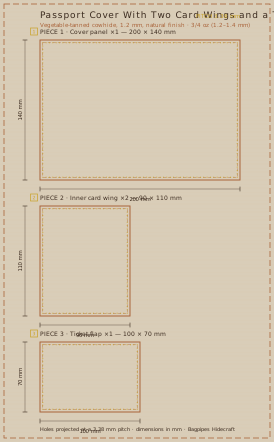
Cut list Hole array drawn from the spacing in the spec table; dimensions in millimetres.
| Piece | Size (mm) | Qty |
|---|---|---|
| Cover panel | 200 × 140 mm | ×1 |
| Inner card wing | 90 × 110 mm | ×2 |
| Ticket flap | 100 × 70 mm | ×1 |
Bench sequence 3.38 mm · 0.6 mm waxed polyester, mid brown
Measure the booklet, not the cover you already own
Passports vary. A 48-page booklet with a stiff cover measures about 125 × 88 × 8 mm; a 64-page one runs to 10 mm thick. Measure yours closed with a rule, add 6 mm to the width and 4 mm to the height, and that is your inner opening. For most booklets that lands on a cover panel 200 mm wide folded at 95 mm and 105 mm.
The two folds create a 10 mm spine. Skive both fold bands from 1.2 mm to 0.6 mm on the flesh side, crease them with a bone folder, and dry them flat for twenty minutes. A cover stitched on wet folds will come out 3 mm wider at the spine than at the opening and the booklet will slide around.
Card wings sit on the inside left, ticket flap inside right
Each wing is a 90 × 110 mm piece with its outer edge flush to the cover edge and its top edge 12 mm below the cover top. That offset leaves a visible strip of the cover panel above each wing, which is what stops a full wing of cards from looking like it was stuck on as an afterthought.
The ticket flap is 100 × 70 mm stitched along its bottom and two sides, open at the top, and mounted 18 mm up from the bottom edge. That height clears a boarding pass folded once. Any lower and the pass catches on the spine when the cover closes.
One seam around the outside, then burnish
Stitch the outer perimeter only — there is no lining in this order, so the inside faces of the cover panel stay raw. That is deliberate: a lined cover doubles the skiving work at every fold and gains nothing on a piece that lives in a jacket pocket.
Bevel and burnish the outside edges with two thin coats of gum, then burnish the raw inner edges lightly so they do not grab the booklet cover. Natural veg-tan darkens on contact with hands; a cover used daily will be a full shade darker within six months, which is the point of leaving it unfinished.
Also filed under Cases & Covers
Cases & Covers · 2026-10-09
Wet-Moulded Axe Sheath With a Stitched Welt
The one rule of an axe sheath is that the blade must never touch the stitch line.
- Bench hours
- 9 h
- Level
- Bench lead
Bags & Pouches · 2026-10-14
A Boxed Dopp Kit: Five Panels, Four Corners, Two Hands
A dopp kit is the first order where you build a three-dimensional object rather than a folded one.
- Bench hours
- 14 h
- Level
- Bench lead
Cases & Covers · 2026-10-09
Wet-Moulded Axe Sheath With a Stitched Welt
The one rule of an axe sheath is that the blade must never touch the stitch line.
- Bench hours
- 9 h
- Level
- Bench lead
Kit profiles
Adhesives
Adhesives: Contact Cement, Open Time and the Ventilation Rule
Contact cement is the strongest and the most misused adhesive on this bench.
- Rows filed
- 5
Blades
Cutting Tools: What Each Blade Is Actually For
Most bench injuries come from using the wrong blade on the wrong cut.
- Rows filed
- 5
-
- Rows filed
- 4