Blades · Reference table · 3 min read
Cutting Tools: What Each Blade Is Actually For
Most bench injuries come from using the wrong blade on the wrong cut. A utility knife that will not go through 3 mm hide gets pushed harder, and the moment it slips it goes into a hand. Matching the blade to the job is a safety practice before it is a quality practice.
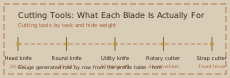
Hole array drawn from the spacing in the spec table; dimensions in millimetres.
Reference table Cutting tools by task and hide weight
| Tool | Blade angle | Best on | Cut quality | Sharpening |
|---|---|---|---|---|
| Head knife | 20–25° | Long curves, skiving, 3 mm and up | Best on curves | Strop every 15 min |
| Round knife | 25–30° | Straight runs, heavy hide | Good, needs pressure | Strop, occasional stone |
| Utility knife | 30° snap-off | Straight cuts in 4/5 oz and thinner | Fast, but follows grain | Snap the segment, replace |
| Rotary cutter | 45 mm wheel | Linings, suede, chamois | Clean, no drag | Replace blade |
| Strap cutter | Fixed fence | Straps from 5/6 to 8/9 oz | Parallel, repeatable | Replace blade every 8 m |
Bench sequence in the order the bench asks for it
The head knife and the pull cut
A head knife cuts on a pull, with the blade rolled through the leather rather than pushed. Grip the handle with the blade at 30 degrees to the surface, start the cut and pull toward yourself, rolling your wrist so the curve of the blade does the work. One pass, 3 mm of shoulder, no drag marks.
The head knife is also the best skiving tool on the bench. To skive a fold, lay the leather flesh side up, put the blade flat against the surface and pull with the edge lifted 2 degrees. You are aiming for a taper, not a step: 1.8 mm down to 0.8 mm over 12 mm of length.
Utility knives: three passes, not one
A snap-off blade is 30 degrees, which is too acute to cut deep leather without following the grain. Use it for a first pass at half depth, a second pass at full depth, and a third to release. Three passes with a straight rule beats one confident diagonal.
Change segments often. A dull snap-off blade does not cut, it crushes: the cut edge comes out compressed and closes up again, so your 38 mm strap ends up 37.2 mm and you find out when the buckle will not fit. On 5/6 oz a segment lasts about 1.5 m of cutting.
Straight lines are a fixture problem, not a skill problem
Long straight cuts go wrong when the rule moves, not when the hand shakes. Clamp a 1 m steel rule with two spring clamps at both ends, or better, use a strap cutter for anything under 50 mm wide. A strap cutter with a fence produces a parallel edge every time and takes a quarter of the time.
When you must cut freehand, mark the line with an awl instead of a pen. A pen line 0.5 mm wide leaves you guessing where the centre is; an awl scratch is a groove the blade drops into, and it does not contaminate the edge with ink that has to be sanded off before finishing.
Sharpening: strop often, grind rarely
A head knife should be stropped every 15 minutes of cutting. Fifteen passes per side on leather with compound takes 30 seconds and keeps the blade cutting rather than crushing. Grinding a head knife is a job for a stone and a jig, and doing it badly removes more steel than a year of use.
Never cut on glass or stone. A self-healing mat is fine for thin leather; for anything over 2 mm use a poly cutting board, which gives the blade somewhere to go at the end of a cut. Striking a hard surface rolls the edge and you will feel it as a drag on the very next cut.
Also filed under Blades
Adhesives · 2026-10-18
Adhesives: Contact Cement, Open Time and the Ventilation Rule
Contact cement is the strongest and the most misused adhesive on this bench.
- Reference table
- 5
-
- Reference table
- 4
Hardware · 2026-09-30
Hardware Finishes and What They Do After Two Years
Hardware is the part of a leather good that fails first and looks worst when it does.
- Reference table
- 6
Edge Finishing · 2026-09-21
The Edge Finish Stack: Bevel, Sand, Seal, Wax
An edge is four operations, in order, and skipping any one of them shows.
- Reference table
- 5
Bags & Pouches · 2026-10-14
A Boxed Dopp Kit: Five Panels, Four Corners, Two Hands
A dopp kit is the first order where you build a three-dimensional object rather than a folded one.
- Bench hours
- 14 h
Cases & Covers · 2026-10-09
Wet-Moulded Axe Sheath With a Stitched Welt
The one rule of an axe sheath is that the blade must never touch the stitch line.
- Bench hours
- 9 h
Belts & Straps · 2026-10-03
A Padded Dog Collar Built From Two Layers
A collar takes more load than any belt on this bench.
- Bench hours
- 6 h