Hand Tools · Reference table · 3 min read
Awls and Needles: Opening a Hole Without Cutting One
An awl is not a punch. A punch removes leather; an awl pushes fibres aside and, when the leather is dry, lets them close back around the thread. That difference is the whole reason a hand-sewn seam holds better than a machine-sewn one, and it is why the awl has to be polished rather than sharp.
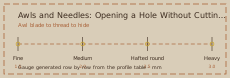
Hole array drawn from the spacing in the spec table; dimensions in millimetres.
Reference table Awl blade to thread to hide
| Awl blade | Blade width (mm) | Thread | Hide weight | Use |
|---|---|---|---|---|
| Fine | 1.5 | 0.45 mm | 2.5/3 – 3/4 oz | Watch straps, small goods, single-hole opening |
| Medium | 2.0 | 0.6 mm | 3/4 – 4/5 oz | The bench default for wallets and bags |
| Hafted round | 2.5 | 0.8 mm | 5/6 – 6/7 oz | Belts, collars, tool rolls, three-layer stacks |
| Heavy | 3.0 | 1.0 mm | 8/9 oz and up | Axe sheaths, harness, wet-moulded work |
Bench sequence in the order the bench asks for it
The blade has to be smooth, not sharp
A stitching awl blade is a tapered diamond that should slide through leather with almost no resistance when it is properly polished. If you can feel it dragging, the blade is either too sharp or has a burr. A sharp awl cuts the fibres you need intact, and the thread then has nothing to grip.
Polish a new blade on a strop with compound, ten passes per face, and re-polish every few hours of use. This is the tool that people sharpen and then wonder why their seams go slack. Stainless is the wrong material for an awl blade — it will not hold a polish as long as high-carbon steel.
Working the awl: two rules
Rule one: the awl goes in at the same angle as the pricking iron, which is perpendicular unless you angled the iron on purpose. Rule two: the awl opens only the hole the needle is about to use — one hole ahead of the front needle, never the whole seam at once. Punching 40 holes and then sewing them means the first 30 have closed again by the time you reach them.
On thick work, dampen the leather slightly before the last 5 mm of the awl pass. A little moisture lubricates the fibres and the awl comes through cleanly. Soaking is not needed and will swell the leather.
Needle size against hole size
The needle must pass through the hole without being forced. If it needs pliers, the hole is too small: go up one awl size, or down one thread size. Forcing a needle flattens the thread against the hole wall and removes about a third of the stitch strength, which is invisible until the seam fails.
Two needles per seam, both the same size. Mixed sizes make the stitch slant uneven on the two faces of the work, which shows on any wallet that is opened flat. On a 0.6 mm thread and 3.38 mm pitch, both needles should be size 003.
Storage, and the blunted tip
Store awls in a block or a roll with the point down and protected. A blade dropped on a concrete floor rolls the point, and a rolled point tears rather than separates fibres. It can be restored on a strop in about ten minutes, but most people do not notice it for weeks.
Replace a hafted awl when the blade has lost more than 20 mm of its length to repeated polishing. A short blade changes the angle you work at and the holes start going in at the wrong depth. Awl blades are cheap; a slack seam is not.
Also filed under Hand Tools
Adhesives · 2026-10-18
Adhesives: Contact Cement, Open Time and the Ventilation Rule
Contact cement is the strongest and the most misused adhesive on this bench.
- Reference table
- 5
Blades · 2026-10-12
Cutting Tools: What Each Blade Is Actually For
Most bench injuries come from using the wrong blade on the wrong cut.
- Reference table
- 5
Hardware · 2026-09-30
Hardware Finishes and What They Do After Two Years
Hardware is the part of a leather good that fails first and looks worst when it does.
- Reference table
- 6
Edge Finishing · 2026-09-21
The Edge Finish Stack: Bevel, Sand, Seal, Wax
An edge is four operations, in order, and skipping any one of them shows.
- Reference table
- 5
Bags & Pouches · 2026-10-14
A Boxed Dopp Kit: Five Panels, Four Corners, Two Hands
A dopp kit is the first order where you build a three-dimensional object rather than a folded one.
- Bench hours
- 14 h
Cases & Covers · 2026-10-09
Wet-Moulded Axe Sheath With a Stitched Welt
The one rule of an axe sheath is that the blade must never touch the stitch line.
- Bench hours
- 9 h
Belts & Straps · 2026-10-03
A Padded Dog Collar Built From Two Layers
A collar takes more load than any belt on this bench.
- Bench hours
- 6 h