Small Goods · Starter bench · 3 Bench hours · 3 min read
A Snap Key Fob in Three Hours From One Offcut
This is the order I hand out when someone has three hours and wants to finish something. One 135 × 25 mm strip of 5/6 oz, one line snap, one key ring. It teaches snap setting, which is the single most common failure point in small leather goods — a badly set snap tears out of the leather within a month and there is no way to repair it without cutting the piece open.
Materials
- Veg-tan offcut5/6 oz, 135 × 25 mm
- Line snap20 mm, antique brass, 4 parts
- Key ring25 mm split ring, brass
Tools
- Snap setter20 mm, with anvil
- Oval punch20 × 5 mm for the snap slot
- Pricking irons4.0 mm
- Burnisherwood or canvas
Bench hours
- 3 hStarter bench
- 4 mmStitch pitch
- 0.8 mm waxed polyester, tanThread
- Vegetable-tanned cowhide, offcut from the wallet ordersHide
- 5/6 oz (2.0–2.4 mm)Thickness
- Hardware
- 3 parts
- Cut list
- 2 pieces
- Published
- 2026-09-06
- Stitch pitch
- 4 mm
Cut list Hole array drawn from the spacing in the spec table; dimensions in millimetres.
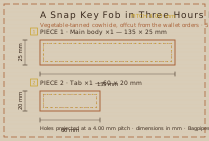
| Piece | Size (mm) | Qty |
|---|---|---|
| Main body | 135 × 25 mm | ×1 |
| Tab | 60 × 20 mm | ×1 |
Bench sequence 4 mm · 0.8 mm waxed polyester, tan
Set the snap on a firm surface, not in the air
A 20 mm line snap has four parts: cap, socket, stud, and eyelet. The cap goes on the grain side, the socket and stud on the flesh side, and they are pressed together with a setter and a steel anvil. The mistake is setting over a cutting mat or a wooden block, which lets the leather compress and the snap crushes unevenly. Use a steel anvil or the flat of a bench vice.
Test the set by snapping and unsnapping ten times. A good snap clicks and holds with two fingers of pull. If the cap spins, the post was too short for the leather thickness — at 2.0 mm you are at the limit for a 20 mm line snap, so skive the two snap positions down to 1.4 mm before setting.
Skive, punch, then set
Skive a 12 mm circle at both snap positions on the flesh side, from 2.0 mm to 1.4 mm. Punch the 5 mm oval slot for the key ring at one end, 8 mm in from the tip, and burnish that slot hard — a raw key ring slot wears through in about a year of daily pocket carry.
The fob folds at 45 mm and the snap sits 110 mm from the folded end. Mark those two positions, punch the snap holes, and set the snap while the leather is still flat. Bending the strip first and then setting the snap is how you end up with a cap that sits at an angle to the leather.
Stitch the body, then the tab
Saddle stitch along both long edges from the fold to 10 mm short of the ring slot, at 4.0 mm pitch with 0.8 mm thread. Ten millimetres of unstitched length at the ring end lets the leather flex instead of cracking where the ring pulls.
Finish with a light bevel and gum on all edges, and give the grain side a coat of beeswax and a buff with a cloth. An offcut fob made in three hours should look like a finished object, not a scrap with a snap in it: the difference is entirely in the edges.
Also filed under Small Goods
Belts & Straps · 2026-10-03
A Padded Dog Collar Built From Two Layers
A collar takes more load than any belt on this bench.
- Bench hours
- 6 h
- Level
- Working bench
Cases & Covers · 2026-09-26
Passport Cover With Two Card Wings and a Ticket Flap
A passport is 125 × 88 mm when closed and 125 × 176 mm when open, which is exactly why most covers are made too tight.
- Bench hours
- 5 h
- Level
- Working bench
Kit profiles
Adhesives
Adhesives: Contact Cement, Open Time and the Ventilation Rule
Contact cement is the strongest and the most misused adhesive on this bench.
- Rows filed
- 5
Blades
Cutting Tools: What Each Blade Is Actually For
Most bench injuries come from using the wrong blade on the wrong cut.
- Rows filed
- 5
-
- Rows filed
- 4