Wallets & Cardholders · Working bench · 9 Bench hours · 3 min read
Vertical Bifold: Eight Folds and Why Each One Gets Skived
This is the first order on the ladder where the arithmetic gets serious. A vertical bifold has eight folds, six pocket mouths and four layers of leather at the spine, and if you do not skive every one of those folds the wallet closes like a wedge and never sits flat. Nine hours, about 0.09 m² of 1.2 mm veg-tan, and roughly 900 stitches at 3.38 mm.
Materials
- Veg-tan cowhide1.2 mm, about 0.09 m²
- Waxed polyester thread0.45 mm dark brown, about 9 m
- Edge paint2 thin coats, outside perimeter only
Tools
- Pricking irons3.38 mm, 2 + 8 + 10 tooth
- Wing dividerset to 3.0 mm
- French skiverfor 0.5 mm fold skives
- Bone folderfor creasing eight folds
Bench hours
- 9 hWorking bench
- 3.38 mmStitch pitch
- 0.45 mm waxed polyester, dark brownThread
- Vegetable-tanned cowhide, drum-dyed through, 1.2 mmHide
- 3/4 oz (1.2–1.4 mm)Thickness
- Hardware
- 2 parts
- Cut list
- 5 pieces
- Published
- 2026-09-12
- Stitch pitch
- 3.38 mm
Cut list Hole array drawn from the spacing in the spec table; dimensions in millimetres.
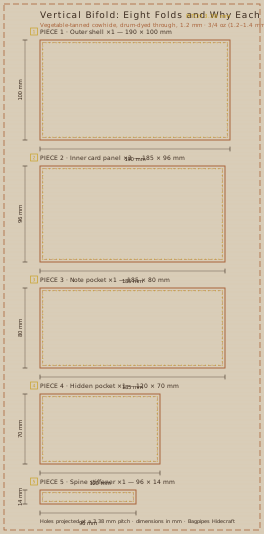
| Piece | Size (mm) | Qty |
|---|---|---|
| Outer shell | 190 × 100 mm | ×1 |
| Inner card panel | 185 × 96 mm | ×2 |
| Note pocket | 185 × 80 mm | ×1 |
| Hidden pocket | 120 × 70 mm | ×1 |
| Spine stiffener | 96 × 14 mm | ×1 |
Bench sequence 3.38 mm · 0.45 mm waxed polyester, dark brown
Lay out all five pieces before you cut one
The outer shell is 190 × 100 mm, folded at 95 mm. Both card panels are 185 × 96 mm. The note pocket is 185 × 80 mm and the hidden pocket is 120 × 70 mm. Cut them all from one panel so the grain and the temper match — mixing two dyes of the same hide is visible in daylight even when it is invisible on the bench.
Mark the fold lines first and crease them with a bone folder on the flesh side. Then skive each crease from 1.2 mm to 0.6 mm across a 12 mm band. Eight folds, eight skives, forty minutes of work that nobody sees and everybody notices when it is missing.
Build the card panels as a ladder
Each card panel takes three slots. The lowest slot is the full width of the panel, the second is 8 mm shorter, the third 16 mm shorter, giving a stepped edge that lets your thumb catch the top card. Stitch the dividers with 3.38 mm irons and 0.45 mm thread before the panels go anywhere near the outer shell.
The step matters more than the pocket depth. A three-slot panel with equal-height slots works for the first month, then the cards settle and all four tops sit level. The 8 mm step is what keeps the second and third cards accessible after the leather softens.
Spine, lining and the four-layer seam
The spine gets a 96 × 14 mm stiffener glued on the flesh side with contact cement, positioned so it stops 3 mm short of the stitch line on both sides. That 3 mm gap is deliberate: it stops the stiffener from being punctured by the irons and gives the fold somewhere to go.
Where the outer shell, both card panels and the note pocket meet at the spine you have four layers, about 4.2 mm of leather. Run the irons through this stack only after skiving all four layers to 0.8 mm in the last 15 mm. Four layers at full thickness will break a 3.38 mm iron tine — the iron is the most expensive tool on this bench, and it is the one that goes first when someone skips the skive.
Close the perimeter in one continuous seam
Stitch the perimeter in one pass, starting and ending at the top of the spine. One continuous seam means one place where the stitches meet, and the meeting point is at the spine where the fold hides it. Two separate seams leave two ends to backstitch, and backstitching on a 3.38 mm pitch looks like a knot.
Finish with a bevel and two thin coats of edge paint on the outside perimeter only. Inside pocket mouths stay raw and get burnished with gum. Then load the wallet with eight cards and twenty notes, close it, and leave it under a 2 kg weight overnight. Leather that has been loaded before it has relaxed will hold the wrong shape permanently.
Also filed under Wallets & Cardholders
Wallets & Cardholders · 2026-08-31
Two-Pocket Card Wallet: 105 × 75 mm and Three Millimetres of Slip
A card wallet fails in one of two ways.
- Bench hours
- 5 h
- Level
- Starter bench
Bags & Pouches · 2026-10-14
A Boxed Dopp Kit: Five Panels, Four Corners, Two Hands
A dopp kit is the first order where you build a three-dimensional object rather than a folded one.
- Bench hours
- 14 h
- Level
- Bench lead
Cases & Covers · 2026-10-09
Wet-Moulded Axe Sheath With a Stitched Welt
The one rule of an axe sheath is that the blade must never touch the stitch line.
- Bench hours
- 9 h
- Level
- Bench lead
Kit profiles
Adhesives
Adhesives: Contact Cement, Open Time and the Ventilation Rule
Contact cement is the strongest and the most misused adhesive on this bench.
- Rows filed
- 5
Blades
Cutting Tools: What Each Blade Is Actually For
Most bench injuries come from using the wrong blade on the wrong cut.
- Rows filed
- 5
-
- Rows filed
- 4