Wallets & Cardholders · Starter bench · 5 Bench hours · 3 min read
Two-Pocket Card Wallet: 105 × 75 mm and Three Millimetres of Slip
A card wallet fails in one of two ways. Either the pockets are cut exactly the width of a credit card and nothing goes in after the first month, or they are cut loose and the cards fan out when you open it. The fix is arithmetic: cut the pocket 3 mm wider than the card, mount it 4 mm above the fold line, and let the outer shell be 2 mm wider again on each side. This order is five hours, one piece of 1.2 mm veg-tan, and 240 stitches.
Materials
- Veg-tan cowhide1.2 mm, about 0.04 m²
- Waxed polyester thread0.6 mm dark brown, about 3.5 m
- Edge paint1 coat, colour matched to thread
Tools
- Pricking irons3.85 mm, 2-tooth + 8-tooth
- Wing dividerset to 3.2 mm
- Skiving knifefor the 0.4 mm fold skive
- Harness needlessize 003, two per seam
Bench hours
- 5 hStarter bench
- 3.85 mmStitch pitch
- 0.6 mm waxed polyester, dark brownThread
- Vegetable-tanned cowhide, 1.2 mm skived to 0.8 mm at the foldsHide
- 3/4 oz (1.2–1.6 mm)Thickness
- Hardware
- 2 parts
- Cut list
- 4 pieces
- Published
- 2026-08-31
- Stitch pitch
- 3.85 mm
Cut list Hole array drawn from the spacing in the spec table; dimensions in millimetres.
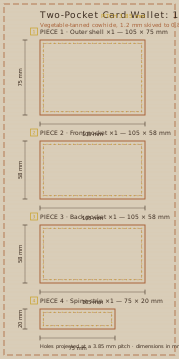
| Piece | Size (mm) | Qty |
|---|---|---|
| Outer shell | 105 × 75 mm | ×1 |
| Front pocket | 105 × 58 mm | ×1 |
| Back pocket | 105 × 58 mm | ×1 |
| Spine strip | 75 × 20 mm | ×1 |
Bench sequence 3.85 mm · 0.6 mm waxed polyester, dark brown
The pocket allowance, worked out once
A standard card is 85.6 × 53.98 mm. Cut your pocket 105 mm wide and 58 mm tall and you have 9.7 mm of slack across the width — too much, cards will swim. The number that behaves is 92 mm wide by 58 mm tall, mounted so its top edge sits 4 mm above the fold, giving 3.2 mm of side slack per card slot. Stack six cards and the leather takes up the rest.
The outer shell is 105 × 75 mm, folded at 37 mm from the bottom. That gives a finished wallet 105 × 75 mm closed, which is 19 mm wider than a card — enough for the spine and a thumb notch, not so much that the wallet feels like a brick in a front pocket.
Skive the folds or the wallet will not close
The outer shell folds at 37 mm, and that fold needs to lose half its thickness or the wallet sits open like a book. Skive the fold band 10 mm either side of the crease from 1.2 mm down to 0.8 mm on the flesh side. Do the same where the pocket tops turn back — a 12 mm band skived to 0.6 mm.
Dampen the fold lines, fold them over a steel rule, and press with a bone folder. Let the leather dry flat for thirty minutes before stitching. If you stitch a wet fold, the leather stretches around the needle and the wallet comes out 2 mm wider on one side than the other.
Saddle stitch from the spine outwards
Mark the stitch line 3.2 mm from the edge with a wing divider, then run the 3.85 mm irons down both sides from the spine outward. Start every seam at the spine: that way any drift ends at the outside edge where it is easy to hide under the finishing bevel, rather than at the spine where it shows at the fold.
Thread 1.2 m of 0.6 mm thread on two size 003 needles and saddle stitch. The rule on this bench is two needles, one at each side, always returning to the same hole in the same order. Pull each stitch to about 60 percent tension, then snug the pair; pulling hard on the first pass deforms the hole and the seam goes wavy by the end.
Edges, and the thumb notch
Bevel, sand and paint the outside edges only. The pocket tops stay raw and burnished with a light coat of gum, because paint on a thin skived edge cracks as soon as a card flexes it. Two thin coats of edge paint on the outer perimeter, twenty minutes apart, is the whole finish.
The thumb notch is a 22 mm semicircle cut from the top centre of the front pocket, or from the outer shell if the pockets are offset. Cut it after stitching, with a 22 mm round punch or a fresh blade against a coin as a template, then burnish the cut. Cutting it before stitching means the pocket edges move while you sew and the notch ends up off-centre.
Also filed under Wallets & Cardholders
Wallets & Cardholders · 2026-09-12
Vertical Bifold: Eight Folds and Why Each One Gets Skived
This is the first order on the ladder where the arithmetic gets serious.
- Bench hours
- 9 h
- Level
- Working bench
Belts & Straps · 2026-10-03
A Padded Dog Collar Built From Two Layers
A collar takes more load than any belt on this bench.
- Bench hours
- 6 h
- Level
- Working bench
Cases & Covers · 2026-09-26
Passport Cover With Two Card Wings and a Ticket Flap
A passport is 125 × 88 mm when closed and 125 × 176 mm when open, which is exactly why most covers are made too tight.
- Bench hours
- 5 h
- Level
- Working bench
Kit profiles
Adhesives
Adhesives: Contact Cement, Open Time and the Ventilation Rule
Contact cement is the strongest and the most misused adhesive on this bench.
- Rows filed
- 5
Blades
Cutting Tools: What Each Blade Is Actually For
Most bench injuries come from using the wrong blade on the wrong cut.
- Rows filed
- 5
-
- Rows filed
- 4