Cases & Covers · Starter bench · 5 Bench hours · 3 min read
Refillable A5 Notebook Cover With a Pen Sleeve
The whole point of a refillable cover is that it outlives the notebook inside it. That only works if the cover is sized to the notebook you can actually buy next year — an A5 refill is 148 × 210 mm, and a cover cut even 4 mm tight will not take a thicker refill with 100 pages instead of 80. Five hours, 0.11 m², one piece plus a sleeve.
Materials
- Veg-tan cowhide1.6 mm, 0.11 m²
- Elastic cord20 mm round, 210 mm
- Waxed thread0.8 mm chestnut, about 5 m
Tools
- Pricking irons4.0 mm, 2 + 6 tooth
- Bone folderfor the two spine folds
- Skiverfor the 0.8 mm spine band
- Round punch4 mm for the cord anchor hole
Bench hours
- 5 hStarter bench
- 4 mmStitch pitch
- 0.8 mm waxed polyester, chestnutThread
- Vegetable-tanned cowhide, 1.6 mm with a 1.0 mm pen sleeveHide
- 4/5 oz (1.6–2.0 mm)Thickness
- Hardware
- 2 parts
- Cut list
- 3 pieces
- Published
- 2026-10-27
- Stitch pitch
- 4 mm
Cut list Hole array drawn from the spacing in the spec table; dimensions in millimetres.
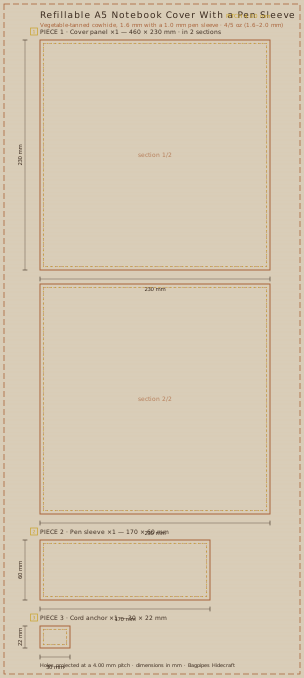
| Piece | Size (mm) | Qty |
|---|---|---|
| Cover panel | 460 × 230 mm | ×1 |
| Pen sleeve | 170 × 60 mm | ×1 |
| Cord anchor | 30 × 22 mm | ×1 |
Bench sequence 4 mm · 0.8 mm waxed polyester, chestnut
Cut for the thickest refill you might buy
A 148 × 210 mm A5 refill runs between 8 mm and 14 mm thick depending on page count. Cut the cover panel 460 × 230 mm and fold at 152 mm and 308 mm, and the spine gap comes out at 156 mm — enough for a 14 mm refill plus the elastic band that holds it, with 4 mm to spare on each side of the block.
Skive both fold bands 12 mm wide down to 0.9 mm from the flesh side, crease, and dry flat. Skipping the skive here is what makes covers that will not lie flat on a desk, which defeats the purpose of a refillable notebook.
The pen sleeve goes on the back, and it must be loose
A 170 × 60 mm sleeve stitched along the top and bottom edges, open at both ends, mounted 20 mm up from the bottom of the back panel. Both ends open is deliberate: a closed-end sleeve traps grit and the pen cap scratches the leather every time it goes in.
The sleeve is cut 12 mm taller than the pen diameter. A 13 mm barrel needs a 25 mm sleeve channel. Cutting it snug is the most common mistake on this order — a snug sleeve will not take a fountain pen with a clip, and it stretches the leather permanently after a week.
Elastic closure: measure it on the closed cover
The closure is a 20 mm elastic cord anchored under a 30 × 22 mm tab riveted to the back panel. Run the cord around the closed cover with a refill inside and note the length, then subtract 15 percent. For an A5 cover that is typically 210 mm before tension, which holds the cover shut without bowing it.
A cord that is too tight bows the front panel outward within a month and the notebook will not sit flat. Too loose and the cover falls open in a bag. Anchor the cord with a rivet through the tab and cord together, not a hole punched through the leather alone.
Finish, then break it in
Bevel and burnish both the outer edges and the sleeve edges with gum, and leave the grain side unfinished. Then load the cover with a refill, close it, and put it under 3 kg of weight overnight. The folds will set at the thickness of that refill, so use the thickest refill you plan to carry.
Also filed under Cases & Covers
Cases & Covers · 2026-10-21
A Wet-Moulded Half Case With a Tripod Boss
A half case has to do two things at once: hold the camera body tightly enough that it does not slide, and let the tripod socket through at exactly the right height.
- Bench hours
- 12 h
- Level
- Bench lead
Cases & Covers · 2026-10-09
Wet-Moulded Axe Sheath With a Stitched Welt
The one rule of an axe sheath is that the blade must never touch the stitch line.
- Bench hours
- 9 h
- Level
- Bench lead
Cases & Covers · 2026-09-26
Passport Cover With Two Card Wings and a Ticket Flap
A passport is 125 × 88 mm when closed and 125 × 176 mm when open, which is exactly why most covers are made too tight.
- Bench hours
- 5 h
- Level
- Working bench
Belts & Straps · 2026-10-03
A Padded Dog Collar Built From Two Layers
A collar takes more load than any belt on this bench.
- Bench hours
- 6 h
- Level
- Working bench
Cases & Covers · 2026-09-26
Passport Cover With Two Card Wings and a Ticket Flap
A passport is 125 × 88 mm when closed and 125 × 176 mm when open, which is exactly why most covers are made too tight.
- Bench hours
- 5 h
- Level
- Working bench
Kit profiles
Care & Feed
Care and Feed: Less Often Than You Think
More leather is ruined by over-oiling than by neglect.
- Rows filed
- 5
Hides
Vegetable-Tanned or Chrome-Tanned: The Choice That Fixes Everything Else
Almost every technique on this bench assumes vegetable-tanned leather.
- Rows filed
- 4
Adhesives
Adhesives: Contact Cement, Open Time and the Ventilation Rule
Contact cement is the strongest and the most misused adhesive on this bench.
- Rows filed
- 5