Hides · Reference table · 3 min read
Hide Weight: What Ounces Mean and When They Stop Working
Leather is sold by weight per square foot in the United States and by thickness in millimetres almost everywhere else, and the conversion is not exact — a 4/5 oz hide is not a fixed 1.8 mm, it is a range the tannery sorts into. Sorting matters more than the number: a hide can be 1.8 mm and firm, or 1.8 mm and floppy, and only one of those makes a good notebook cover.
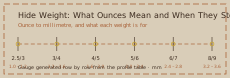
Hole array drawn from the spacing in the spec table; dimensions in millimetres.
Reference table Ounce to millimetre, and what each weight is for
| Weight (oz) | Thickness (mm) | Firmness | Best use | Avoid for |
|---|---|---|---|---|
| 2.5/3 | 1.0 – 1.2 | soft to medium | Linings, thin card slots, suede | Anything load-bearing |
| 3/4 | 1.2 – 1.6 | medium | Wallets, card holders, watch straps | Belts, bag gussets |
| 4/5 | 1.6 – 2.0 | medium firm | Notebook covers, aprons, small bags | Hand-stitched tight curves |
| 5/6 | 2.0 – 2.4 | firm | Bags, camera cases, dog collars | Wallet interiors |
| 6/7 | 2.4 – 2.8 | firm | Tool rolls, briefcase gussets | Folded linings |
| 8/9 | 3.2 – 3.6 | very firm | Belts, collars, sheaths, straps | Anything needing a 3 mm fold |
Bench sequence in the order the bench asks for it
The conversion, and where it lies
One ounce equals 1/64 inch, or about 0.4 mm. So 4 oz is 1.6 mm, 6 oz is 2.4 mm and 8 oz is 3.2 mm. The ranges exist because a hide is not uniform: the butt is thicker and firmer than the belly, and a tannery sells a whole hide at an average weight. That is why a 5/6 oz shoulder and a 5/6 oz belly behave nothing alike.
Buy shoulder or butt for anything structural and belly for linings and small flat goods. A 3/4 oz shoulder makes a wallet that holds its shape for a decade; a 3/4 oz belly makes the same wallet and it is soft within a year.
Temper: the property nobody writes on the label
Temper is how much the leather resists bending, and it is decided by the tannery's fatliquoring, not by thickness. Ask for firm temper when you need structure. On a notebook cover, a firm 1.6 mm panel holds an A5 refill upright; a soft 1.6 mm panel sags and the cover curls around the block.
The test at the bench: hold a 100 mm strip of the hide out horizontally. A firm temper drops 20 to 30 mm at the tip. A soft one drops 60 mm or more. Do this before you cut, not after, because the whole order depends on it.
What each weight refuses to do
Every weight has a fold it cannot take. 8/9 oz will not fold back on itself without a skive down to 1.2 mm; force it and the grain cracks along the fold within weeks. 3/4 oz will not hold a bag gusset upright — it collapses at the first load, which is why gussets are cut from 4/5 oz or heavier.
5/6 oz will not make a good wallet interior. It is 2.0 mm at the thinnest, and six card slots of it come to 12 mm of leather in a pocket. This is the single most common weight error on the bench: too heavy for interiors, too light for structure.
Buying: one big panel beats four small ones
A 0.3 m² panel of good 4/5 oz shoulder costs more per square decimetre than four 0.08 m² offcuts, but the offcuts have four different tempers and four different dye lots. On a project with five panels that match, that difference is visible.
Buy the whole panel for anything over three pieces, cut the largest pieces first and work down. Store the rest flat under a board with a weight on it, never rolled — rolled leather takes a set within a month and a rolled hide cut later will not lay flat on the bench.
Also filed under Hides
Adhesives · 2026-10-18
Adhesives: Contact Cement, Open Time and the Ventilation Rule
Contact cement is the strongest and the most misused adhesive on this bench.
- Reference table
- 5
Blades · 2026-10-12
Cutting Tools: What Each Blade Is Actually For
Most bench injuries come from using the wrong blade on the wrong cut.
- Reference table
- 5
-
- Reference table
- 4
Hardware · 2026-09-30
Hardware Finishes and What They Do After Two Years
Hardware is the part of a leather good that fails first and looks worst when it does.
- Reference table
- 6
Bags & Pouches · 2026-10-14
A Boxed Dopp Kit: Five Panels, Four Corners, Two Hands
A dopp kit is the first order where you build a three-dimensional object rather than a folded one.
- Bench hours
- 14 h
Cases & Covers · 2026-10-09
Wet-Moulded Axe Sheath With a Stitched Welt
The one rule of an axe sheath is that the blade must never touch the stitch line.
- Bench hours
- 9 h
Belts & Straps · 2026-10-03
A Padded Dog Collar Built From Two Layers
A collar takes more load than any belt on this bench.
- Bench hours
- 6 h