Thread · Reference table · 3 min read
Thread Size, Needle Size and How Much to Cut
Cutting thread is where beginners waste the most material. The working rule is that a length of thread sews about 45 percent of its own length in saddle stitch, because every stitch passes through the hole twice and each pass is longer than the pitch by the thickness of the leather. The table gives the measured figure for each diameter on two thicknesses of hide.
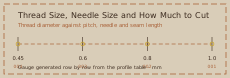
Hole array drawn from the spacing in the spec table; dimensions in millimetres.
Reference table Thread diameter against pitch, needle and seam length
| Thread (mm) | Needle size | Pitch (mm) | Seam length per metre of thread | Notes |
|---|---|---|---|---|
| 0.45 | 004 | 2.7 – 3.0 | about 0.42 m | Linen grips better; use for thin hides |
| 0.6 | 003 | 3.0 – 3.85 | about 0.45 m | The bench default for wallets and bags |
| 0.8 | 002 | 3.85 – 4.0 | about 0.46 m | Belts, collars, tool rolls |
| 1.0 | 001 | 4.0 – 4.5 | about 0.48 m | Heavy goods; needs a 4.5 mm awl to open the hole |
Bench sequence in the order the bench asks for it
Two needles, one thread, and the 45 percent rule
Saddle stitch uses one thread with a needle on each end. A stitch consumes twice the hole-to-hole distance on the surface plus twice the thickness of the work, so the ratio of thread used to seam produced is roughly 2.2 to 1. Cut for the seam you are about to sew plus 200 mm of tail, never for the whole bag at once.
Long working lengths are the second most common mistake. Anything over 1.6 m drags on the bench, picks up grit, and frays at the wax where it passes back and forth through the same hole 30 times. On a 260-stitch seam, sew it in three or four 1.4 m lengths and overlap the joins under a stitch.
Polyester against linen
Waxed polyester is stronger, rot-proof and cheaper; it is the default on this bench for anything that gets wet. Waxed linen is slightly weaker but grips the leather better, which matters at 2.7 to 3.0 mm pitch on a 1.2 mm hide where polyester will pucker the seam as you tension it.
Whichever you use, wax matters more than fibre. Thread that has lost its wax — old spools, spools left in a hot car — will knot and fray. If a spool feels dry, pull 2 m and run it across a block of beeswax twice before threading up.
Needles: size, and the blunt point
Harness needles are blunt on purpose; they follow the hole the awl or the iron made instead of cutting a new one. A sharp needle on leather severs fibres beside the stitch and the seam tears out under load. Match the needle to the thread: 004 for 0.45 mm, 003 for 0.6 mm, 002 for 0.8 mm, 001 for 1.0 mm.
If a needle has to be pushed with pliers, the hole is too small for the thread. Enlarging the hole by force squeezes the thread flat and the stitch loses about a third of its strength. Go up one awl size or down one thread size instead.
Finishing: backstitch, melt, and the last two stitches
Finish a seam with two backstitches, then run the needles through the last layer of leather to the inside and cut flush. Melting a polyester tail with a lighter and pressing it flat is acceptable on the inside of a bag; on a wallet interior it leaves a hard bead that wears the cards, so bury the tail between the layers instead.
On linen, never melt. Tie an overhand knot pulled tight against the leather with a needle, then thread the tail back under four stitches and cut it 3 mm long. A knotted linen tail that has been run back under stitches is the most durable finish available and it is invisible from both faces.
Also filed under Thread
Adhesives · 2026-10-18
Adhesives: Contact Cement, Open Time and the Ventilation Rule
Contact cement is the strongest and the most misused adhesive on this bench.
- Reference table
- 5
Blades · 2026-10-12
Cutting Tools: What Each Blade Is Actually For
Most bench injuries come from using the wrong blade on the wrong cut.
- Reference table
- 5
-
- Reference table
- 4
Hardware · 2026-09-30
Hardware Finishes and What They Do After Two Years
Hardware is the part of a leather good that fails first and looks worst when it does.
- Reference table
- 6
Bags & Pouches · 2026-10-14
A Boxed Dopp Kit: Five Panels, Four Corners, Two Hands
A dopp kit is the first order where you build a three-dimensional object rather than a folded one.
- Bench hours
- 14 h
Cases & Covers · 2026-10-09
Wet-Moulded Axe Sheath With a Stitched Welt
The one rule of an axe sheath is that the blade must never touch the stitch line.
- Bench hours
- 9 h
Belts & Straps · 2026-10-03
A Padded Dog Collar Built From Two Layers
A collar takes more load than any belt on this bench.
- Bench hours
- 6 h