Belts & Straps · Working bench · 6 Bench hours · 3 min read
A Hand-Stitched Watch Strap at 3.0 mm Pitch
A watch strap is the smallest object on this bench and the least forgiving. Twenty millimetres of width, a 1.4 mm thick skin, and two spring bars that will be pulled on every time the watch is put on. Cut it at 4 mm pitch and the strap looks like a belt for a hamster; leave the tail at full thickness and it stands up off the wrist like a spade handle. Six hours, 0.02 m² of hide.
Materials
- Firm veg-tan1.4 mm, 0.02 m²
- Waxed linen thread0.45 mm cream, about 5 m
- Stainless hardware20 mm buckle, keepers, spring bars
Tools
- Pricking irons3.0 mm, 2 + 8 tooth
- Round hole punch2.0 mm for the stitch holes at the lugs
- Skiverto thin the tail to 0.8 mm
- Strap cutterset to 20 mm
Bench hours
- 6 hWorking bench
- 3 mmStitch pitch
- 0.45 mm waxed linen, creamThread
- Vegetable-tanned cowhide, firm temper, 1.4 mmHide
- 3.5/4 oz (1.4–1.6 mm)Thickness
- Hardware
- 3 parts
- Cut list
- 3 pieces
- Published
- 2026-09-18
- Stitch pitch
- 3 mm
Cut list Hole array drawn from the spacing in the spec table; dimensions in millimetres.
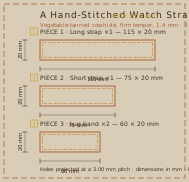
| Piece | Size (mm) | Qty |
|---|---|---|
| Long strap | 115 × 20 mm | ×1 |
| Short strap | 75 × 20 mm | ×1 |
| Lug band | 60 × 20 mm | ×2 |
Bench sequence 3 mm · 0.45 mm waxed linen, cream
Pitch first, everything else second
At 20 mm wide you have room for exactly one line of stitching down each side at 3.0 mm pitch, 3.0 mm in from the edge. Anything coarser reads as a belt strap. Anything finer than 2.7 mm on a 1.4 mm skin perforates the leather so heavily that the strap tears at the lug — the leather between two adjacent holes drops below 0.9 mm of remaining web.
On a 20 mm strap the two stitch lines leave a 14 mm centre channel. That channel is where the leather must bend around the wrist, so it is also where you skive: the tail tapers from 1.4 mm at the keeper to 0.8 mm at the tip over the last 65 mm.
The lug end takes the load
Spring bars tear out of straps because the bar hole is punched too close to the edge. On a 20 mm strap, the bar hole centre should sit 4.5 mm in from each side and 6 mm down from the lug edge. That leaves 2.5 mm of leather between the hole rim and the strap edge, which is the minimum for a 2.0 mm bar hole.
The lug band is a 60 × 20 mm piece folded over the spring bar and stitched to the main strap on the flesh side. Stitch it with a double row, not a single: the fold takes the entire load of the watch, and a single row of 3.0 mm stitches will stretch within a year of daily wear.
Stitch wet leather only when you have to
Case the leather — dampen it evenly and let it return to nearly dry — before folding the lug band, so the fold takes a crease instead of cracking. Then let it dry completely before stitching. Stitching damp leather means every hole closes around the needle and the finished seam sits in a trench.
Use a 1.1 m length of 0.45 mm waxed linen, two size 004 needles, and saddle stitch both lines in the same direction so the stitch slant matches on both sides. Linen grips better than polyester on a thin strap and holds the taper without puckering, which polyester will do at 3.0 mm pitch.
Finishing a 20 mm edge
Edge paint on a 1.4 mm strap looks heavy. Instead, bevel with a #0 beveler (0.8 mm), sand at 600 grit, dampen, and burnish with canvas and a little gum. Two passes gives a rounded, dark edge that matches the taper instead of fighting it.
Punch the buckle holes at 25 mm intervals — five holes is standard, giving 100 mm of adjustment — then fit the spring bars and wear the strap for an hour before you call it finished. Leather that has been worn for an hour will show you the one place the skive was too abrupt, and it is always at the tail.
Also filed under Belts & Straps
Belts & Straps · 2026-10-03
A Padded Dog Collar Built From Two Layers
A collar takes more load than any belt on this bench.
- Bench hours
- 6 h
- Level
- Working bench
Belts & Straps · 2026-08-28
A 38 mm Single-Prong Belt That Starts as a Straight Blank
The plain belt is the cheapest way to learn the three skills every later order depends on: cutting a strap dead straight, holding a constant distance from the edge, and setting hardware without splitting the hide.
- Bench hours
- 4 h
- Level
- Starter bench
Bags & Pouches · 2026-10-14
A Boxed Dopp Kit: Five Panels, Four Corners, Two Hands
A dopp kit is the first order where you build a three-dimensional object rather than a folded one.
- Bench hours
- 14 h
- Level
- Bench lead
Cases & Covers · 2026-10-09
Wet-Moulded Axe Sheath With a Stitched Welt
The one rule of an axe sheath is that the blade must never touch the stitch line.
- Bench hours
- 9 h
- Level
- Bench lead
Kit profiles
Adhesives
Adhesives: Contact Cement, Open Time and the Ventilation Rule
Contact cement is the strongest and the most misused adhesive on this bench.
- Rows filed
- 5
Blades
Cutting Tools: What Each Blade Is Actually For
Most bench injuries come from using the wrong blade on the wrong cut.
- Rows filed
- 5
-
- Rows filed
- 4