Pricking Irons · Reference table · 3 min read
Pricking Iron Pitch: Choosing by Hide Weight, Not by Fashion
Pitch is the distance between two tine tips, and it is the first decision on every order because it fixes thread size, needle size and how much leather is left between holes. The rule that keeps a seam strong is simple: the gap of uncut leather between two holes should never be less than the thread diameter times two. Everything in the table above follows from that one number.
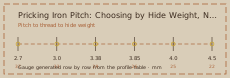
Hole array drawn from the spacing in the spec table; dimensions in millimetres.
Reference table Pitch to thread to hide weight
| Pitch (mm) | Stitches per 100 mm | Thread | Hide weight | Typical use |
|---|---|---|---|---|
| 2.7 | 37 | 0.45 mm | 2.5/3 oz | Watch straps, card pockets, small goods |
| 3.0 | 33 | 0.45–0.6 mm | 3/4 oz | Card holders, thin wallets, linings |
| 3.38 | 29 | 0.6 mm | 3/4 – 4/5 oz | Wallets, notebook covers, messenger bags |
| 3.85 | 26 | 0.6–0.8 mm | 4/5 – 5/6 oz | Bags, camera cases, general bench work |
| 4.0 | 25 | 0.8 mm | 5/6 – 8/9 oz | Belts, straps, collars, tool rolls |
| 4.5 | 22 | 1.0 mm | 8/9 oz and up | Heavy collars, axe sheaths, harness |
Bench sequence in the order the bench asks for it
Fine pitch is not automatically better
Fine pitch looks impressive on a card holder and destroys a belt. At 2.7 mm on a 3.6 mm belt you leave 2.2 mm of leather between holes, and every one of those webs is a stress riser. A belt worn daily flexes about 40 times a day at the buckle fold, and a fine-pitch seam there fails by tearing web by web rather than all at once.
Work the other way: choose the pitch from the hide weight, then choose the thread from the pitch. A 5/6 oz bag at 3.38 mm would need 0.6 mm thread, which looks thin on a panel that size. The same bag at 3.85 mm with 0.8 mm thread has a stitch line that reads correctly from a metre away.
Tine count, and why three irons beat one
A 2-tooth iron sets the corner and gets you around curves; a 6 or 8-tooth covers the straight runs. Buy both. Working a whole seam with a 2-tooth iron means 260 strikes on a wallet perimeter instead of 70, and every strike is a chance to tilt the iron and drift off the line.
For a 3.38 mm set, the 8-tooth covers 23.7 mm per strike and the 2-tooth handles corners and the last 5 mm before a seam end. Two irons, one pony, and a maul of about 450 g is a complete stitching kit for everything on this bench up to a messenger bag.
Reading the iron, reading the hole
A correctly driven iron leaves a hole that is narrow on the surface and widens below — a diamond, not a slot. If the holes look like slots, you are striking too hard or the iron is dull, and a slot hole lets the thread pull through and the seam goes slack in a month.
Check the iron by driving it into a scrap of the same hide and looking at the exit face. The tines should come through cleanly with no tearing at the edges. Tearing on exit means the iron needs polishing, and a few passes on a strop with green compound brings a good iron back in five minutes.
Sharpening, storage and the wear limit
Never touch a pricking iron with a file. They are hardened and the tines chip. Polish them on a leather strop with compound, four passes per face, and store them in a tool roll rather than a drawer, where tines hit each other and bend. A bent tine cannot be straightened back to a usable tolerance.
A cheap iron set will drift in pitch by about 0.1 mm over three years of daily work, and by then the holes no longer line up over a long seam. Check a set once a year: drive an 8-tooth iron, measure across the seven gaps with calipers, and if the total has moved more than 0.3 mm, retire it to cutting paper patterns.
Also filed under Pricking Irons
Adhesives · 2026-10-18
Adhesives: Contact Cement, Open Time and the Ventilation Rule
Contact cement is the strongest and the most misused adhesive on this bench.
- Reference table
- 5
Blades · 2026-10-12
Cutting Tools: What Each Blade Is Actually For
Most bench injuries come from using the wrong blade on the wrong cut.
- Reference table
- 5
-
- Reference table
- 4
Hardware · 2026-09-30
Hardware Finishes and What They Do After Two Years
Hardware is the part of a leather good that fails first and looks worst when it does.
- Reference table
- 6
Bags & Pouches · 2026-10-14
A Boxed Dopp Kit: Five Panels, Four Corners, Two Hands
A dopp kit is the first order where you build a three-dimensional object rather than a folded one.
- Bench hours
- 14 h
Cases & Covers · 2026-10-09
Wet-Moulded Axe Sheath With a Stitched Welt
The one rule of an axe sheath is that the blade must never touch the stitch line.
- Bench hours
- 9 h
Belts & Straps · 2026-10-03
A Padded Dog Collar Built From Two Layers
A collar takes more load than any belt on this bench.
- Bench hours
- 6 h